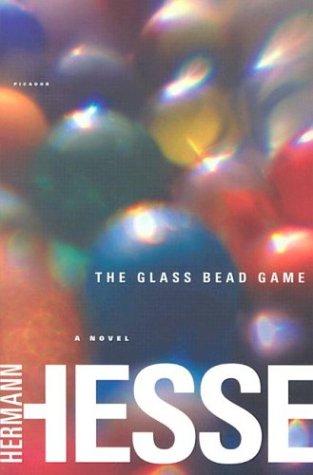
I need to say up front, this book withholds the thing its whole premise is built around, the glass bead game itself, a formalized art of connecting ideas across mathematics, music, philosophy, whatever domain of human thought you like, into a kind of played synthesis, is never actually demonstrated on the page in any concrete way. You get descriptions of its prestige, its rituals, its place at the center of the reclusive scholarly province of Castalia, but never a single move explained clearly enough that you could picture playing it yourself. I went in annoyed by that. I came out thinking it might be the smartest choice in the whole book, because any concrete version of the game Hesse actually wrote would have been smaller than the idea of it.
Framed as a biography of Joseph Knecht, written centuries later by an admiring but not uncritical fellow Castalian, the book spends most of its length on Knecht’s education and rise within this walled-off intellectual utopia, and the real tension isn’t plot so much as a slow argument, Hesse working out through Knecht’s life whether a life devoted entirely to pure intellectual contemplation, cut off from the mess of ordinary human need, is actually a virtue or a kind of elegant cowardice. Knecht’s friendship with Plinio Designori, who leaves Castalia for the real world and needles Knecht about his isolation for decades, carries almost the entire philosophical weight of the book, and their debates are where it’s genuinely alive rather than stately.
The three “lives” Knecht writes as a student, appended at the end, are where a handful of readers I’ve talked to say the real payoff sits, small parable stories that reflect his eventual choice back at you from an angle the main narrative never takes directly. It’s a slow, deliberately arid read in places, Hesse is not interested in pace, but Knecht’s final decision to leave Castalia, and what happens right after, recontextualizes four hundred pages of abstraction into something that actually costs him something. Not a book I’d hand someone wanting momentum. A book I’d hand someone wondering if a life spent entirely inside their own head is a life well spent.